
Blog — 7 March 2023
FORBIDDEN
CITY
The Catacombs of Paris
Bodies. Remains. Corpses. Cadavers. Graves. Vaults. Crypts. Tombs. The profusion of words we have to describe our transition to the Hereafter, serves to underline our morbid fascination with death. A very human thing in us all. I am going to add two more words to our far-from-comprehensive list: catacomb and ossuary. The thought entered my head before Christmas when I was giving a church tour to a charming quartet of people. Jim Law and his wife Marilyn had travelled from New Zealand and were staying with their friends from Chalfont St. Peter, Ray and Diane Waite. A farmer from the North Island, Jim was sporting a very attractive Patagonia fleece bearing the emblem “Palliser Farm”. In discussion, he told me he owned Palliser Farm, which lay atop the ridge in Cape Palliser, overlooking Palliser Bay.
No prizes for guessing that he would be interested in Sir Hugh Palliser. Actually, Jenny, our churchwarden, had forewarned of this interest having been well briefed by Ray Waite. I took them on a tour of the church, pointing out some interesting artefacts, including the memorial tablet to Admiral Palliser, on the vestry side of the chancel. The conversation was lively as I reached the first arch in the North aisle, by the nave. With a theatrical flourish that would have made any ham actor wince, I announced I was standing above the remains of Sir Hugh. The Vache Vault was under my feet. As they departed, Jim asked if the Vache Vault was open to the public. I offered to check under the carpet, but Jim politely and sensibly declined. The exchange, though, made me realise we would both have looked, given the opportunity. Such is the infatuation with bones and final resting places.
Paris is one of my favourite cities and the conversation with Jim reminded me of one of its less well-known attractions. The Catacombs of Paris are an underground network of tunnels, covering over 200 kilometres as they intertwine maze-like in a subterrestrial, alternative world. They are almost as old as the church of St Giles and date back to the 13 th century as Parisians excavated limestone to build their city. The same lutetian limestone used in the construction of La Cathedrale de Notre Dame. Depending on the limestone deposits, narrow tunnels can emerge into massive, open caverns and canyons. Imagine a series of underground quarries, connected by tunnels as wide as an avenue, or so narrow in parts that one must crawl. The larger underground open spaces are propped up by huge pillars as the workers dug around the stone to prevent the ceiling collapsing. In some parts, the pillars can be six metres in diameter! The excavation continued unabated for over five hundred years, until cracks appeared during the reign of Louis XVI. These “cracks” took the form of subsidence as houses and entire streets fell into the caverns below. In 1777, the King ordered a program of renovation and maintenance on all underground chambers. In conducting the repairs, the workers followed the streets above, thus creating the “ville sous la ville”. Indeed, many of the underground streets have signs bearing the name of the street above. It also explains why today, Paris remains a low-rise city since the tunnels prevent the deeper foundations required for skyscrapers.
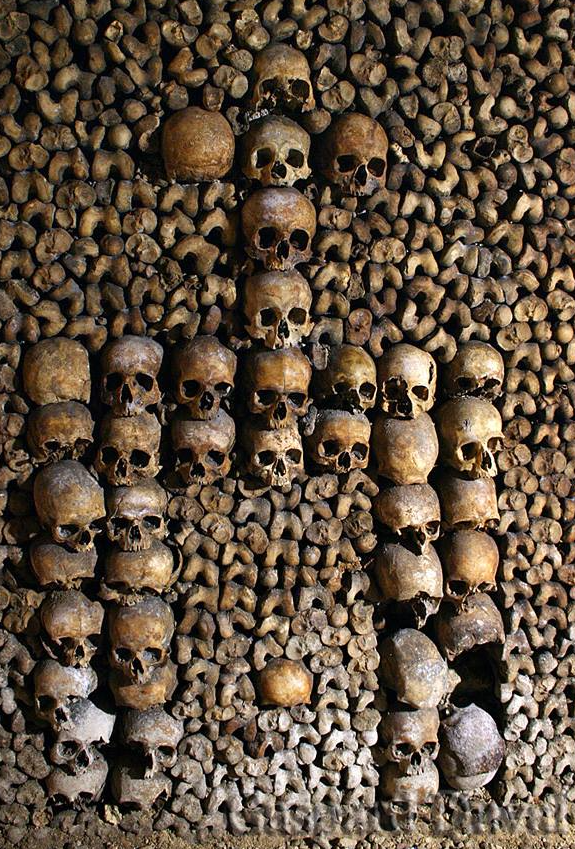
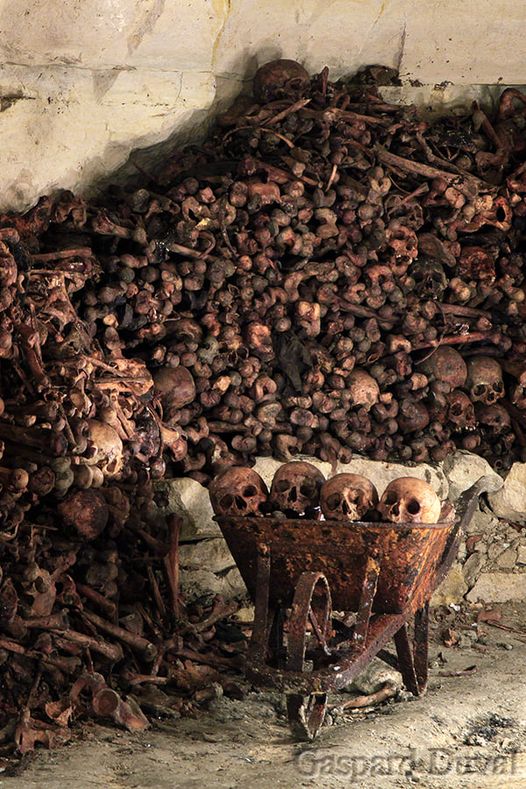
The “Ossuary” part of our story began in 1784. (For clarity, the word defines a room where bones of the dead are placed.) Paris was expanding rapidly and there was pressure on scarce land resources. As the population exploded, cemeteries could not cope. Following the collapse of a cemetery in 1784, Louis XVI decreed that the older cemeteries be emptied, and the bones placed in the recently fortified tunnels under the city: the Catacombs were born! The practice ceased in the 1880s. By then, over six million bodies had been placed in what “remains” today the biggest ossuary in the world. In some areas, they arranged the bones in patterns to create walls. In other parts, the bones form towers, over twenty metres in height.
The official tour of the Catacombs begins at an unimposing green gate in La Place Denfert- Rochereau. A cloistered, winding staircase descends some twenty metres underground before arriving at a sinister, stone doorway:
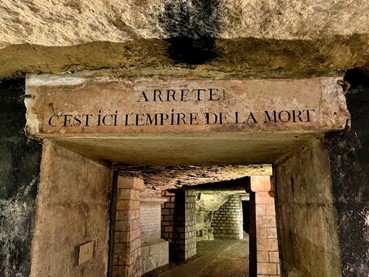
The official tour lasts around one hour and reveals some amazing structures where the patterns of bones have been organised to create sculptures. At once a unique prospect and a bizarre spectacle, the Catacombs have their own special atmosphere. Next time you are in Paris, do try this tour. It will linger in the memory.
However, what really plucks the strings of imagination is the realisation that the official trip covers less than one percent of that shadowy subterranean network. The rest of the underground city is forbidden access. What secrets are concealed in the other ninety-nine percent of this Forbidden City?
One man has dedicated fifteen years of his life to revealing what the forbidden Catacombs contain. Gaspard Duval is a sixty-two-year-old photographer who has specialised in photographing hard-to-reach parts of Paris. In 2008, he was walking along a disused tunnel when he discovered a hole in the ground. Shining his torch into it, he saw considerable depth and obvious signs of ancient workings.
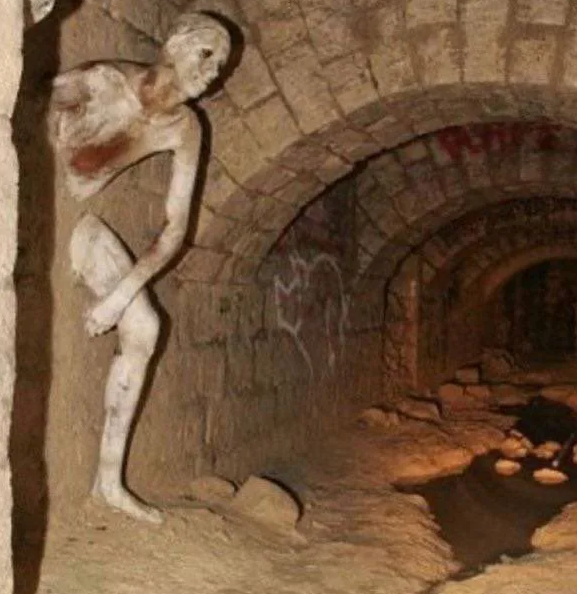
He climbed down gingerly and thus started a fifteen-year exploration of over two-hundred kilometres of tunnels. Gaspard has taken many thousands of photographs which he has used to shed light on the most obscure corners of the Catacombs. He is today the most prominent “Cataphile”, a French term used to describe those who explore these tunnels regularly, enthralled by their history. One terrifying prospect encountered by Gaspard was “La Passe Muraille”, a sculpture of a man, half-emerging from a wall. The creation of another Cataphile with a devilish sense of humour! It is the depiction of a character from a short story by Marcel Ayme, though I doubt if anyone would tarry long enough to figure that out in these ghostly surrounds!
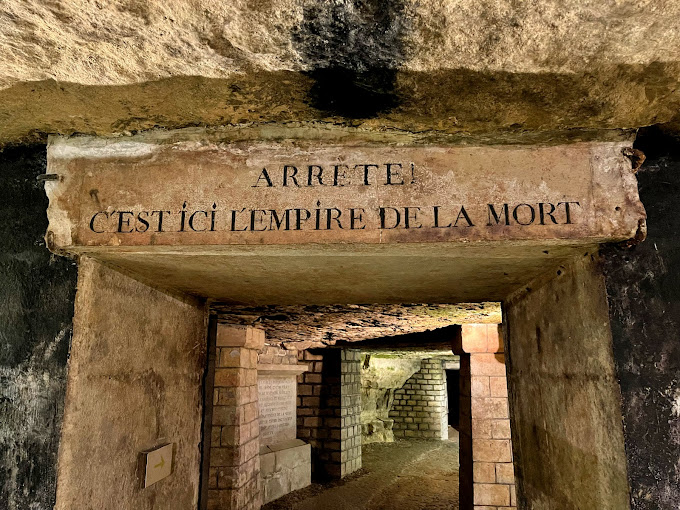
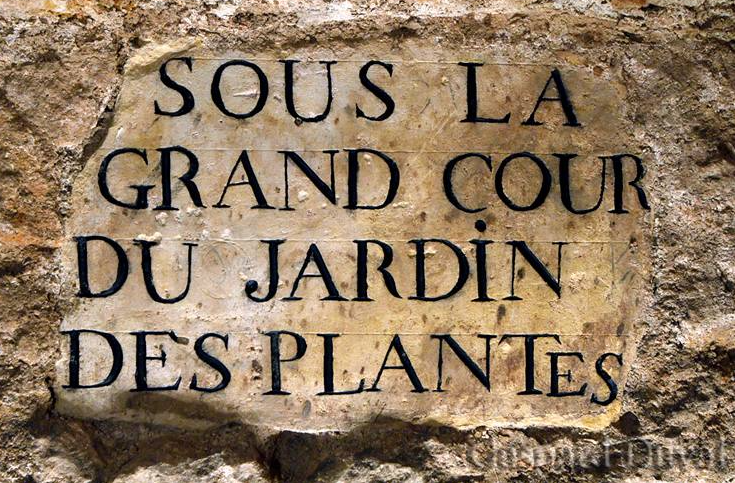
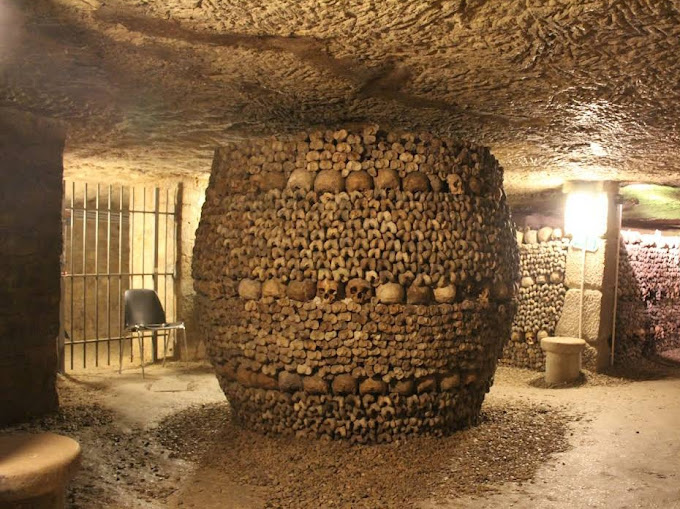
Gaspard Duval’s photos are featured with his kind permission, and appear extensively in Gilles Thomas’ excellent book “Paris sous Paris”.